
Understanding Off-Grid Solar Systems and Battery Storage
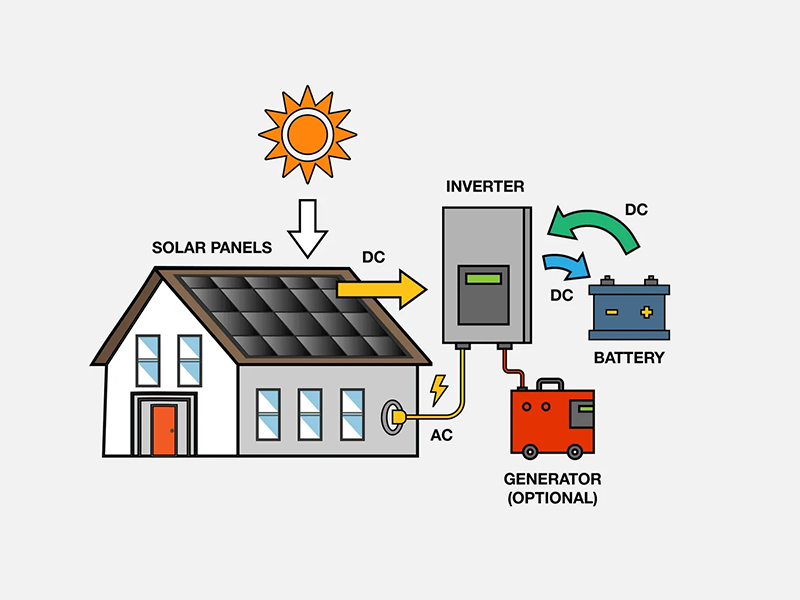
First, what does “off-grid” actually imply? It means you’re completely disconnected from the utility company. Your power comes from the sun during the day, and the excess gets stored in a battery for night use. The Solar Power System with 10KWH Battery is your energy reservoir—think of it as a fuel tank that holds roughly 10,000 watt-hours. That’s enough to run a fridge for about 15 hours, a TV for 50 hours, or a laptop for 200 hours. But here’s the catch: if you use more than you generate, the lights go out. So, the question isn’t just “how big is the battery?” but “how disciplined is your consumption?”

Key Components: Solar Panels, Inverter, Charge Controller, and 10kWh Battery
Let’s break down the four musketeers of your system. Solar panels capture sunlight. But they output DC electricity. Your home uses AC. That’s where the inverter steps in, flipping DC to AC. The charge controller acts as the traffic cop, preventing the battery from overcharging or draining too fast. And the battery itself? For Solar Power System with 10KWH Battery, you’re typically looking at lithium-ion (like LiFePO4) or lead-acid. Lithium wins on lifespan and depth of discharge—you can use 80-90% of its capacity without harm, while lead-acid prefers only 50%.
Here’s a quick comparison to help you choose:
| Feature | Lithium-Ion (LiFePO4) | Lead-Acid (AGM/Gel) |
|---|---|---|
| Usable capacity | 80-90% | 50% |
| Lifespan (cycles) | 4,000-6,000 | 500-1,000 |
| Weight (for 10kWh) | ~100 kg | ~250 kg |
| Maintenance | None | Periodic watering |
| Upfront cost (USD) | $2,500-$4,000 | $1,200-$1,800 |
Sizing and Designing Your 10kWh Off-Grid System
How many solar panels do you need to fill that 10kWh battery daily? It depends on your location’s sun hours. A place like Phoenix gets 5-6 peak sun hours; Seattle gets 2-3. For the average, let’s say 4 hours. You’d need panels generating about 2.5kW per hour to hit 10kWh daily. That’s roughly six to eight 350W panels. You also need to account for inefficiencies. Inverters lose about 10%, and cloudy days happen. So, oversize by 20-30%.
Installation Best Practices and Safety Considerations
Installing this isn’t a weekend DIY unless you’re an electrician. The high-voltage DC from panels is dangerous—arcs can ignite fires. Start with a proper racking system that’s tilted to your latitude. For the battery, ventilation is key, especially for lead-acid, which off-gasses hydrogen. And please, use a disconnect switch between the panels and the inverter. Placing the battery outdoors in freezing temps is not a correct choice. Lithium ions slow down in cold weather, reducing capacity. Keep it in a conditioned space—your garage or utility room works fine.