

Why Off-Grid Solar with Battery Storage Is the Future in 2026
The year 2026 marks a quiet revolution in energy independence. Across remote farmlands, coastal cabins, and even suburban backyards, homeowners are severing their ties to the utility grid with a quiet click of a disconnect switch. The catalyst is not just rising electricity rates—which have climbed nearly 40% in some regions since 2023—but the remarkable efficiency gains in solar panels and the plummeting cost of high-density storage. A decade ago, off-grid living meant constant anxiety about cloudy weeks and generator fuel. Today, a well-designed system delivers seamless power through storms, heatwaves, and even seasonal darkness, thanks to smart energy management that feels almost invisible in daily life.
The psychological shift is equally profound. Owning your power generation creates a sense of security that no utility contract can match. When neighbors face rolling blackouts during wildfire season or polar vortex events, off-grid households sit in warm, well-lit rooms, their refrigerators humming steadily. This resilience is becoming a status symbol—not of wealth, but of foresight and self-reliance.
Top Battery Technologies: Lithium-Ion, Solid-State, and Flow Batteries
The heart of any modern off-grid system is its storage medium. Lithium-iron-phosphate (LFP) batteries dominate the 2026 market, offering 6,000+ cycles and a 15-year lifespan at a cost below $400 per kilowatt-hour. They handle daily deep discharges without degradation, making them the pragmatic choice for most homes. Emerging solid-state batteries, while still pricey at $600/kWh, provide nearly double the energy density and zero thermal runaway risk—ideal for compact installations in tight spaces.
For larger estates or microgrids serving multiple buildings, vanadium flow batteries offer a fascinating alternative. Their liquid electrolyte can be cycled indefinitely without wear, and capacity can be expanded by simply adding more storage tanks. The catch is their size: a 50 kWh flow battery occupies a small shed, with pumps and plumbing that require periodic attention. A quick comparison helps clarify the landscape:
How to Size Your Off-Grid System: Solar Panels, Inverters, and Batteries
Proper sizing transforms a frustrating system into a silent workhorse. Begin with a detailed energy audit—list every appliance, its wattage, and daily usage hours. A typical family of four consumes 25–35 kWh daily, but this varies wildly with electric heating, well pumps, or EV charging. Solar array sizing follows a simple rule: multiply daily consumption by 1.5 to account for inefficiencies, then divide by your region’s peak sun hours. A home in Arizona (6.5 peak hours) needs just 8 kW of panels, while the same home in Michigan (4 hours) requires 13 kW.
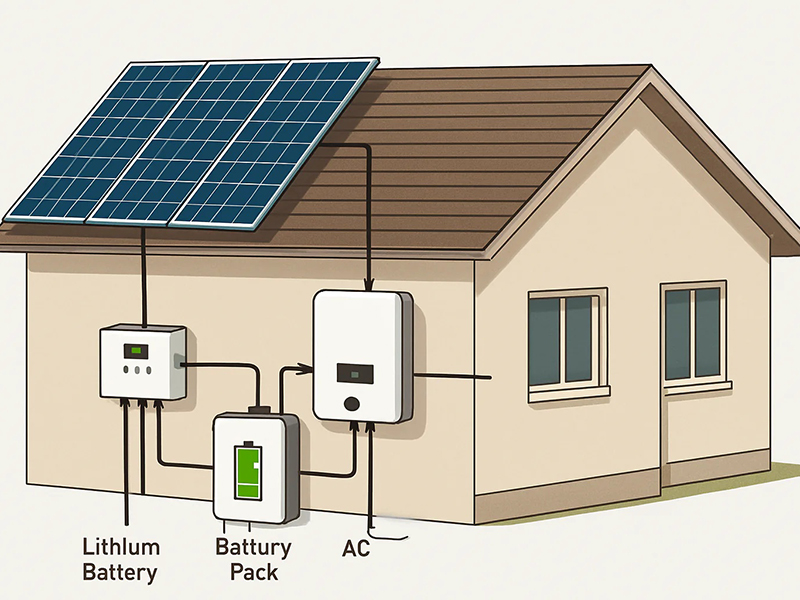
Battery capacity should cover three consecutive overcast days, but beware of oversizing—a battery that rarely discharges below 80% will degrade faster due to lithium plating. String inverters remain cost-effective for simple arrays, while microinverters shine in shaded, multi-orientation roofs. The quiet hero is the hybrid inverter, which manages solar, battery, and generator inputs simultaneously while prioritizing solar power during daylight and reserving battery charge for evening peaks.
Cost Breakdown and ROI of Off-Grid Systems in 2026
The upfront price still makes people blink—a complete 10 kW system with 30 kWh of LFP storage runs between $28,000 and $42,000 installed. Panels account for roughly 30% of the cost, batteries 40%, inverters and balance-of-system 20%, and labor 10%. Yet the math shifts dramatically over time. With utility rates averaging $0.28/kWh in 2026, the same system saves $3,200 annually in avoided electricity bills. Add in the 30% federal tax credit extended through 2026, and the payback period compresses to 6–8 years—after which you're essentially producing electricity at $0.05/kWh for two decades.
Consider the hidden returns: no monthly grid connection fees (which have ballooned to $25–$50 in many states), protection from rate spikes, and a potential 8–12% increase in property value for a fully functional off-grid system. For remote properties where grid extension quotes exceed $60,000, the ROI becomes immediate and irrefutable.